Oslo Airport Gardermoen requires grease-free ventilation ducts. So far, one system has documented that it meets the requirement
Avinor Oslo Airport requires that no grease enters the ventilation ducts from the restaurant kitchens. So far, Lynx Kitchen is the only equipment that has documented that it meets this requirement over time.
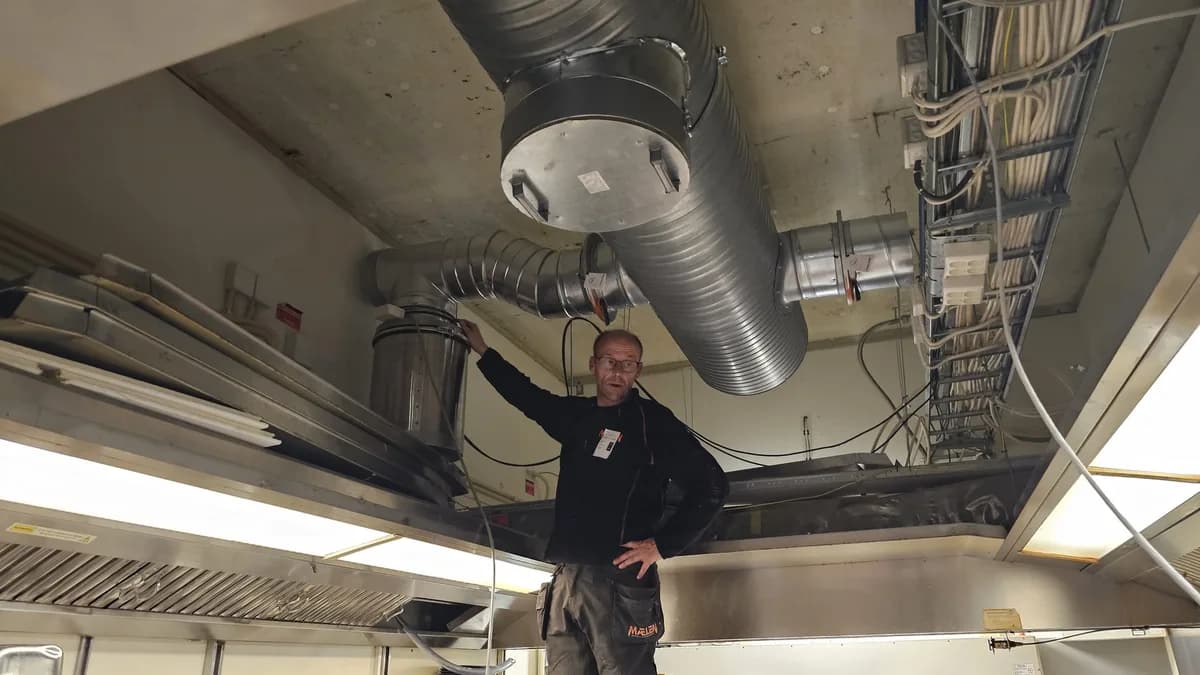
Grease in kitchen exhaust is a well-known problem in buildings with commercial kitchens. Grease particles and aerosols follow the airflow past the hood and settle in the ductwork. There they build up until the next duct cleaning. The deposits increase the fire risk, cause odour and require regular cleaning. They also make heat recovery from the kitchen exhaust difficult, because grease ruins the heat exchanger.
Current regulations require grease filters, cleaning routines and duct cleaning. They do not say how much grease is too much. The industry requirements measure that the routines have been carried out. They do not measure whether the duct is actually clean.
The requirement: No grease in the duct
Oslo Airport has chosen a different approach. The requirement is that no grease shall enter the duct from the restaurants.
The Lynx Kitchen pilot at Gardermoen was designed around this requirement. Cameras in the duct after the hood filmed the entire trial period, eight months without a break. The result was zero liquid grease in the duct. Lynx is still in operation, and the ducts are still free of combustible grease.
The grease is removed in the hood
Lynx Kitchen is a mechanical separator mounted in the kitchen hood. The technology comes from separation in the oil and gas industry and was developed in collaboration with SINTEF and NTNU. The separator uses centrifugal force to separate out liquid droplets, including grease and water, down to 0.1 micrometres. The grease is collected and drained off. It does not follow the airflow on into the ductwork.
The system has no consumable parts, since it cleans itself. A camera in the duct documents the condition continuously. The building owner can therefore verify that the duct is clean, without relying on the cleaning routines having been followed.
“The question has long been how often the duct needs to be cleaned. At Gardermoen they have turned the question around. They require that the grease does not enter the duct at all, and that this can be documented,” says Sondre K. Jacobsen of Lynx Kitchen.
Opening up heat recovery from kitchen exhaust
Kitchen exhaust air has a high and steady temperature for much of the day and is among the most energy-rich airflows in a building. This warm air is usually discharged straight outside, because the grease would ruin the heat exchanger. When the grease is removed at the source, the economics of the rest of the system change as well.
For the building owner, this means less duct cleaning, longer filter life and the possibility of profitable heat recovery. Of particular interest is the option of returning the kitchen exhaust air to the air handling unit instead of routing it separately over the roof. In new buildings, this can remove the need for dedicated shafts, an extra plant room and roof penetrations for the kitchen exhaust.
At Gardermoen, the heat exchanger has run on cleaned kitchen exhaust for more than a year. The dry filters downstream also last longer when they no longer have to capture grease in liquid form and only have to handle dry particles. Filter cassettes that have to be replaced every other week without a separator have lasted three to five months with Lynx in front.
Other building owners can set the same requirement
The requirement at Gardermoen applies to Oslo Airport. It does not appear that the industry itself will consider introducing such a requirement. Until then, other airports and building owners are free to set their own requirements. The building owner is responsible for fire safety in the building and cannot sign this responsibility away in the lease with the restaurant. A requirement for a documented grease-free duct gives the building owner a measurable basis for following up that responsibility.