There Is No Grease Limit to Hide Behind in Norway
Duct cleaning runs on a calendar, not on actual condition. Lynx Kitchen changes the premise — grease never accumulates.
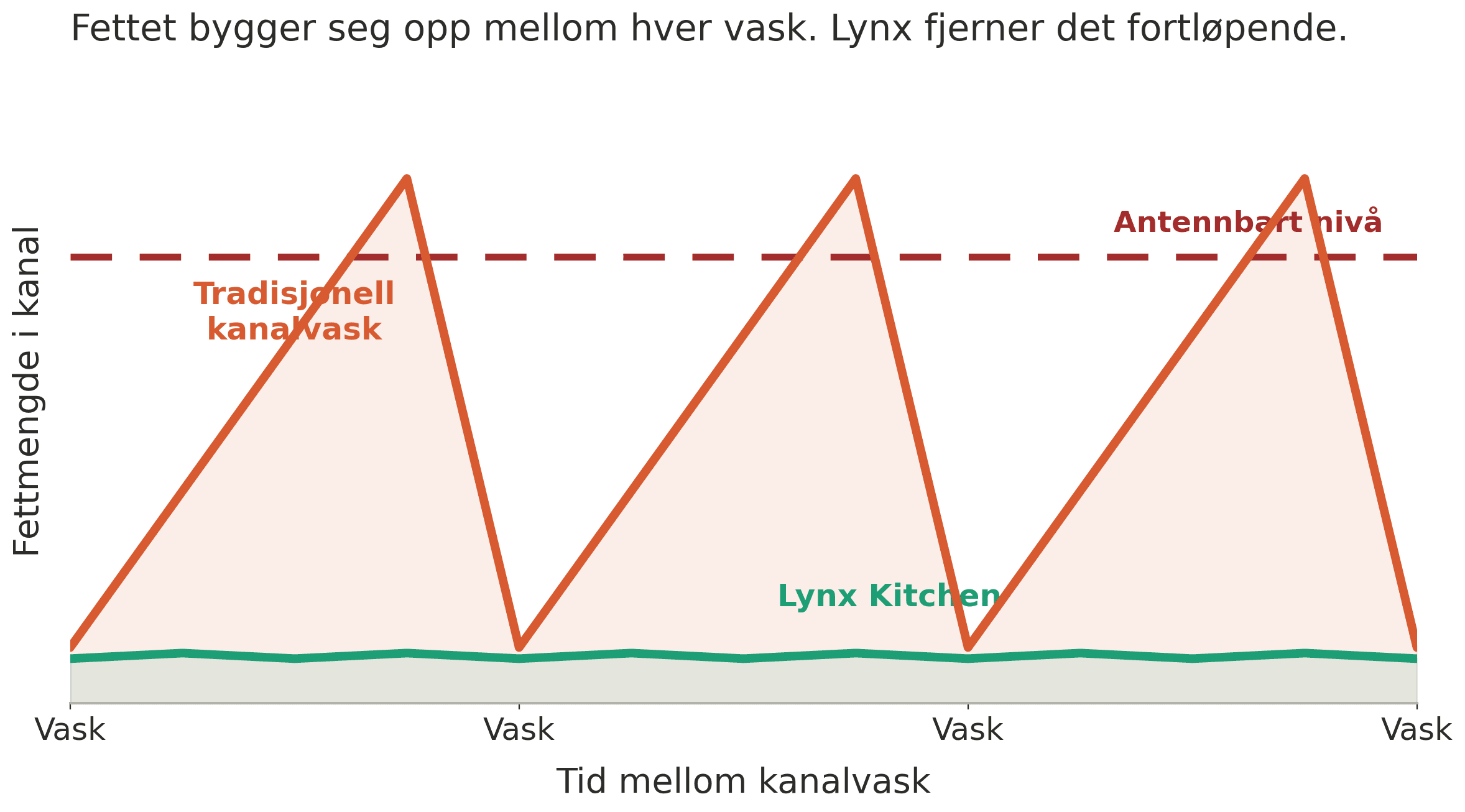
You may think a duct cleaning service agreement keeps you safe. It keeps you safe in the hours right after the clean. For the rest of the year, nobody knows how much combustible grease is sitting in the duct — because duct cleaning runs on a calendar, not on actual condition.
And if a fire does break out, there is no threshold you can point to as proof that you did enough. When a fire broke out in Grünerløkka in 2023, the manager was convicted of negligence. Not for exceeding a grease limit, but because cleaning and maintenance of the extraction system were not good enough. Responsibility rests with the operator and owner — and it is judged after the fact, once the damage is done.
This is where Lynx Kitchen changes the premise. 100% of all liquid-phase grease is captured continuously, before it can settle in the duct. No layer ever builds up waiting for the next clean. Risk is not reduced between two cleans. It is gone the entire time.
Remove the grease, and you remove the basis for the fire. That is precisely why Avinor has chosen Lynx as the ventilation standard at Oslo Airport Gardermoen.
For a design engineer, kitchen extraction is one of the more demanding fire safety points to address. Today's regulations are built around limiting the consequences of a grease fire — not removing the cause.
Ducts from commercial kitchens must be executed in EI 30, A2-s1,d0 all the way to the exhaust grille, or routed in a dedicated shaft. NS-EN 16282-5 requires contamination checks at least every six months, with cleaning as needed. Common to all requirements is the assumption that grease will accumulate in the system. They manage a risk they take as given.
It is worth noting that DSB has no specific requirements for duct cleaning — only a clear responsibility placed on owner and user. The industry acknowledges this is too loose: work is now underway on a new Norwegian guidance document for the design, installation and operation of kitchen extraction as integrated systems. Stricter and more specific requirements are probable, not improbable.
This is where Lynx Kitchen changes the assumption. Lynx captures 100% of all liquid-phase grease continuously, before it settles in the duct. The duct is clean from day one — not because it is washed, but because grease never accumulates. Performance is documented over five years at a reference installation in Trondheim with no manual duct cleaning, and with continuously camera-documented duct condition.
In practice for the design engineer:
Lynx is mounted onto an existing hood through a ø360 mm aperture, connected to 220 V as plug & play, and requires no modification to the duct routing. Connection ø250 mm, capacity 850 m³/h, pressure drop 180 Pa, power 90 W, weight 17 kg, mounting horizontal or vertical. Grease is discharged via hose to an existing grease collector.
And because all grease is captured in liquid form, the need for ozone and UV treatment falls away. Ozone-resistant components can therefore be removed from the specification. Fewer components to dimension, calculate and document.
You are no longer designing to manage grease in the duct. You are designing it out. That is the only position that is safe regardless of how requirements evolve — because with Lynx, there is never grease in the duct.