When Grease Never Reaches the Duct: Is a Consequence-Based Guideline Already Outdated?
NemiTek has taken the initiative for a Norwegian kitchen extraction guideline based on the Swedish Imkanal model. But the entire logic rests on one assumption: that grease enters the duct. That assumption no longer holds.
In the article "Kjøkkenavtrekk – et svakt punkt i brannsikkerheten" (Kitchen extraction – a weak point in fire safety, https://www.nemitek.no/storkjokkenventilasjon/kjokkenavtrekk-et-svakt-punkt-i-brannsikkerheten/427615), published on 8 May 2026, NemiTek has taken the initiative for a Norwegian guideline for the design, installation and operation of kitchen extraction, with the Swedish Imkanal model as its starting point. The initiative is right and important. But before the industry spends years translating and adapting a Swedish framework from 2010, it should ask one fundamental question: What does the guideline actually regulate?
The answer is consequence. Imkanal links kitchen type, equipment and risk, and provides differentiated requirements for fire resistance in the duct, cleaning intervals, dampers and suppression systems. The entire logic rests on one assumption: that grease enters the duct, builds up over time and becomes ignitable. That is why you need to know whether the kitchen has deep fryers, charcoal grills or gas — because the grease load in the duct determines how strict the measures must be.
That assumption no longer holds.
Lynx Kitchen separates 100 percent of the liquid grease droplets from the extract air, continuously, mounted upstream of the duct and fan. The grease never enters the duct. And here is the point the industry must take on board: grease settles over time in all kitchen types, including simple regeneration kitchens and canteens. It happens more slowly than with frying and deep-frying, but over five to fifteen years it builds up and becomes ignitable regardless. A guideline that differentiates measures by kitchen type does not solve this problem. It manages it.
This turns the premise for consulting on its head. How do you advise on the fire classification of a duct, on cleaning intervals, on zoning by kitchen type, when the grease load in the duct is zero regardless of what is cooked in the kitchen? When the cause has been removed at the source, large parts of the differentiated framework become an answer to a problem that no longer exists.
Our point is not that the guideline is unnecessary. It is that a guideline which merely codifies today's consequence-based thinking is outdated before it is even finished. A forward-looking Norwegian guideline must distinguish clearly between two different strategies: limiting the consequence of grease in the duct, and removing the cause of grease getting there at all. It should define what correct design looks like when source separation is installed and a grease-free duct can be guaranteed — not just how to clean and fire-protect a duct you have accepted will get dirty.
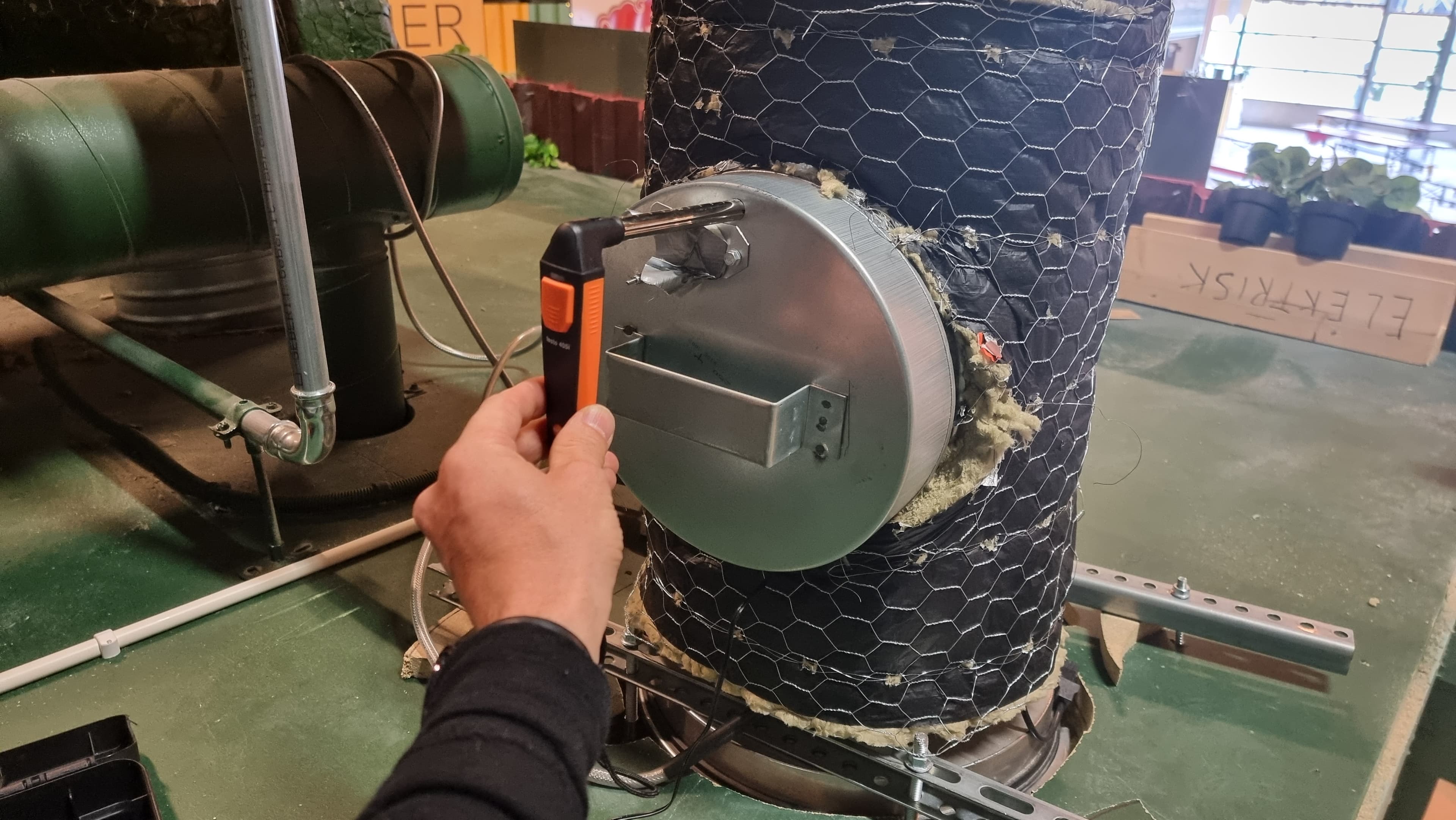
This is not a theoretical discussion. At Oslo Airport Gardermoen, Lynx Kitchen is the only documented solution that meets Avinor Oslo Airport's requirements for grease separation from kitchen ventilation, in one case mounted inside a hood from another manufacturer. We have five years of camera-documented operation showing a clean duct, and an ongoing research project with SINTEF on heat recovery immediately downstream of Lynx — something that only becomes practical once the outgoing air is grease-free.
We invite NemiTek, VKE, Norconsult, VentiStål and the other parties in the guideline work to take up the debate: What is best practice for kitchen extraction when grease is guaranteed to be removed at the source? That question should be asked now, not after a consequence-based guideline has been adopted.