Now You Can Calculate What the Exemption Costs You
Kitchen exhaust is exempt from the heat recovery requirement. The only documented reason is grease. Two new calculators show what the exemption costs per year, and what it costs to remove the cause.
Norwegian building regulations require at least 80 percent heat recovery on ventilation air. Kitchen exhaust is exempt. The same pattern appears in Swedish BBR, Danish BR18 and in the EU ecodesign regulation for ventilation units. The reasoning is identical everywhere: grease from cooking settles in the duct and in the heat exchanger, and a system that fouls with grease is neither reliable in operation nor defensible in fire terms.
The exemption has gone unchallenged because it has been technically correct. But it has never been priced. A restaurant that blows warm exhaust air straight out through every operating hour, all year, loses energy that appears in no accounts at all. That heat is neither metered nor invoiced. It is simply gone.
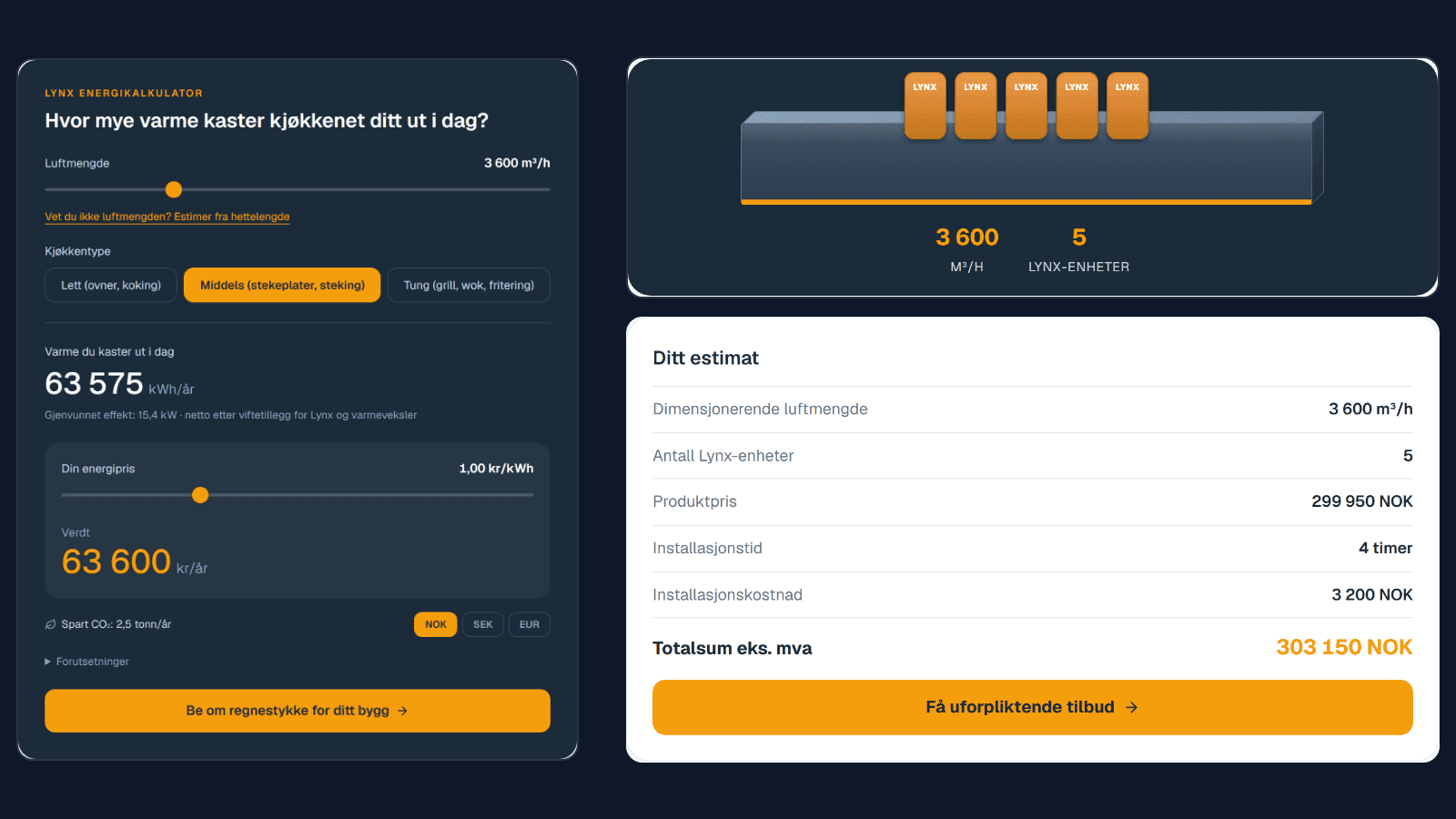
There is now a calculator on lynxkitchen.com, under Calculator in the menu, that works out the loss for a specific installation. A medium duty restaurant kitchen at 3,600 cubic metres per hour yields just over 63,000 kilowatt hours a year of available heat, net of the fan penalty for both the Lynx units and the heat exchanger. At an energy price of one krone per kilowatt hour that is around 63,600 kroner a year, and 2.5 tonnes of CO2 on the Nordic electricity mix.
Every assumption behind the figure is visible on the page: 85 percent temperature effectiveness, 4,320 operating hours a year, temperature lift by kitchen type, and a deduction for 330 pascal of combined pressure drop. We count sensible heat only. The latent heat in vapour comes on top and is deliberately excluded. An engineer who wants to check the number should be able to do so without asking us for anything.
One qualification matters and appears on the page as well. The calculator shows the energy available in the exhaust air. It does not show energy any installation captures by itself. The precondition for recovering it is a duct that stays clean, and that is precisely what the exemption is about.
That is where the second figure comes in. Lynx Kitchen captures 100 percent of the liquid grease droplets from 0.1 micron upward, continuously, in a single centrifugal stage, placed immediately after the hood before grease reaches the duct network. At Oslo Airport Gardermoen, Caverion Norge opened four units after fourteen months of operation and found more than six kilograms of collected grease. The spiral duct downstream was visually clean. That is grease which would otherwise have been sitting in the duct, standing in the way of recovery.
The second calculator sizes the installation. The number of units follows from the airflow, one unit per 850 cubic metres per hour. The same kitchen at 3,600 cubic metres per hour needs five units, and installation takes four hours. No duct modification and no welding, just one opening and a power outlet per unit. The unit price is published openly on the product page, because the question comes anyway, and because a figure you can retrieve yourself is worth more than a figure you have to ask for. Installation rates vary by market, so those we quote on request.
The two numbers belong together, but they should not be set directly against each other. Lynx removes the grease. The heat exchanger captures the heat. It comes in addition, and its cost depends on the installation. What Lynx does is move heat recovery from being ruled out to being a calculation you can actually run.
This is also our central message at Driftskonferansen 2026. Grease in the duct is not a cleaning problem. It is a design problem. Once grease is removed at source, the technical justification for the exemption falls away, and kitchen exhaust moves from being exempt because grease stood in the way to being a recoverable stream like any other. With the recast EPBD requiring zero-emission new public buildings from 2028 and all new buildings from 2030, it is a question of time before that distinction can no longer be defended.